Few African-American school superintendents in California
Fermin Leal/EdSource Today
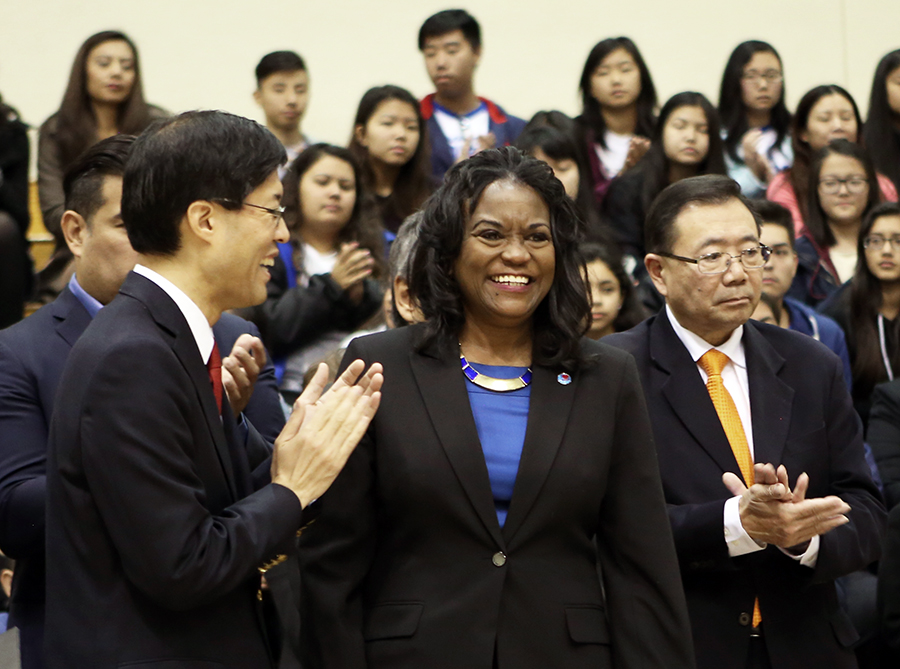
LA Unified Superintendent Michelle King at 1 of her showtime public appearances later on her appointment equally superintendent in January 2016.
 Fermin Leal/EdSource Today
LA Unified Superintendent Michelle King at i of her beginning public appearances after her date as superintendent in January 2016.
When Michelle Male monarch was appointed to head the Los Angeles Unified School District last week, she became the most prominent African-American school superintendent in the state and the nation.
Merely her ascent to the top post is hardly typical of California districts. She is one of only a small number of African-American superintendents in California, and of an even smaller number of African-American women to head a schoolhouse district in the land.
There are an estimated 25 African-American superintendents in California – or 2.half dozen percent of superintendents in the 947 simple, high schoolhouse and K-12 districts in the country, co-ordinate to a list compiled by the California Association of African-American Superintendents and Administrators, or CAAASA. In addition, two other African-Americans are elected county superintendents of pedagogy, and some other is an appointed county superintendent.
Past comparison, of the state'due south 6.ii one thousand thousand public school students, vi percent are African-American.
African-American women are peculiarly underrepresented. Women make up more than two-thirds of African-American teachers in the state but but 25 pct of African-American superintendents.
To accost the upshot, CAAASA has established a "California African American Leadership Academy," which is holding a series of workshops to provide support and training to aspiring superintendents. Established in collaboration with the Association of California School Administrators, the California School Boards Clan and the California Department of Didactics, the next workshop will exist held in Oakland on Jan. 30.
In a newspaper outlining the launch of the program, CAAASA argues that "African Americans often run into a drinking glass ceiling: an invisible, yet very present, bulwark that keeps them from ascension to positions of leadership, regardless of their qualifications and achievements."
Crucial to the selection process are the recruiting firms that school boards typically contract with to identify candidates. The firms ofttimes aren't aware of potential candidates from diverse backgrounds, said CAAASA Executive Director Dwight Bonds. The system has invited leading recruiting firms to attend its events to meet potential candidates and discover them making presentations so they can be more in the mix of names that search firms offer to schoolhouse boards.
"If in that location isn't the opportunity for these search firms to know about these potential candidates from diverse backgrounds, the status quo volition continue," said Bonds.
Carl Cohn, the newly appointed manager of the California Collaborative for Educational Excellence, said that African-American superintendents in the state have had an impact far exceeding their numbers. "While their numbers may be small, the African-American superintendents that I know and have worked with are a very impressive group," said Cohn, who was formerly the longtime superintendent in Long Beach Unified and subsequently in San Diego. "They're all what I call 'little ego' superintendents who are getting great results for kids without creating chaos and conflict in the communities that they serve."
"That's the ballgame for me: good results without conflict in communities that already have likewise much conflict," he said. If Los Angeles' King can go like outcomes, he said, "the LA Unified board has made a very smart choice."
There are nearly 3 times more Latino superintendents than African-American superintendents in the state, co-ordinate to David Verdugo, executive director of the California Clan of Latino Superintendents. An estimated 73 Latino superintendents comprise vii.7 percent of superintendents in the state, three times the proportion of African-American superintendents.
But compared to the large number of Latinos in the land'south schools, who brand upwardly 53 percent of educatee enrollment, Latino superintendents are fifty-fifty less reflective of the country'south student population. And so clearly in that location is considerable room for growth in Latino school leadership every bit well.
An EdSource report in 2006-07 found that principals were twice as likely as superintendents to be racial or ethnic minorities, suggesting that many of them either don't aspire to higher positions, or tin't break what Bonds described as the barriers that even so exist for promotion to the top job in a district.
CAAASA president Judy White, who has been superintendent of the 34,000-student Moreno Valley Unified for the past five years, welcomed King's appointment, which she said "gives me hope for the people of California."
But the small number of African-American superintendents, she said, "does give you pause, and brand you lot wonder if there is more that tin be done."
She worried that without African-Americans in leadership positions, the needs of African-American students tin can "go an reconsideration."
Wesley Smith, executive managing director of the Association of California School Administrators, said the disparities in African-American and Latino representation are "indicative of disparities throughout our organization."
"This is precisely why nosotros must be held answerable for the access and opportunity gaps as well as the persistent accomplishment gaps as we develop a new statewide accountability organization and continuous improvement organization," said Smith, who is participating in the Leadership University being hosted past CAAASA in partnership with other organizations.
Santa Cruz County Office of Pedagogy Superintendent Michael Watkins is one of iii African-American canton superintendents in California'southward 58 counties. Typically, these are elected rather than appointed posts. When Watkins was first elected in 2006, he was the kickoff African-American to be elected to a county superintendent's position in the state. Noting that there is non a single African-American school board member in Santa Cruz County, he said greater variety on schoolhouse boards would contribute to greater variety in schoolhouse district leadership too.
"Nosotros demand to educate educators about what equity ways," Watkins said. "Information technology is not hiring someone because of their skin color. It is nigh having a various community that represents the demographics of our state."
At the aforementioned time, he said, having people of color in superlative posts in a schoolhouse district provides essential role models for African-American students, which in turn contributes to their long-term success. "Young African-Americans demand to see more people like themselves who have accomplished, and non just President Obama," Watkins said.
LA Unified'south King, in an electronic mail to EdSource, affirmed Watkins' sentiments. "As i of the few female African American superintendents in California, I have a responsibility to serve as a model and a source of inspiration to students," she said. "They demand to know that no matter who y'all are or where you lot come from, yous can attain your dreams."
Ramona Bishop, superintendent of Vallejo Metropolis Unified, and CAAASA's president-elect, said that being a superintendent is "not for everyone." Many administrators prefer to exist at the senior executive level in a district, non necessarily in the top chore, which typically becomes highly politicized and is characterized by high turnover. Prospective applicants need encouragement and back up to achieve for the top positions, she said.
The challenge of promoting diversity in superintendency ranks is no unlike from those of other sectors of the economy. "Yous look at the elevation levels of any organization, and you volition discover the aforementioned bug nosotros are struggling with," she said. "We have piece of work to do."
Santa Cruz's Watkins said that fifty-fifty if there is not sufficient progress in the "raw numbers" of school district leaders, he sees more awareness of the challenges facing African-American students. Adjacent week, for case, all county superintendents volition review a "blueprint for activity" focused on African-American students. "In the one-time days that would not have happened," he said.
That is a first step in increasing the pipeline of students going to higher, and some of them choosing careers in didactics, which downwards the road will interpret into more superintendents of color. "You lot have to start at the beginning," he said.
* Vincent Matthews was appointed state administrator for the district past the California Department of Education.
** Arlando Smith is a co-superintendent.
To become more than reports like this one, click here to sign up for EdSource'south no-cost daily email on latest developments in instruction.
Source: https://edsource.org/2016/few-african-american-school-superintendents-in-california/93539
0 Response to "Few African-American school superintendents in California"
ارسال یک نظر